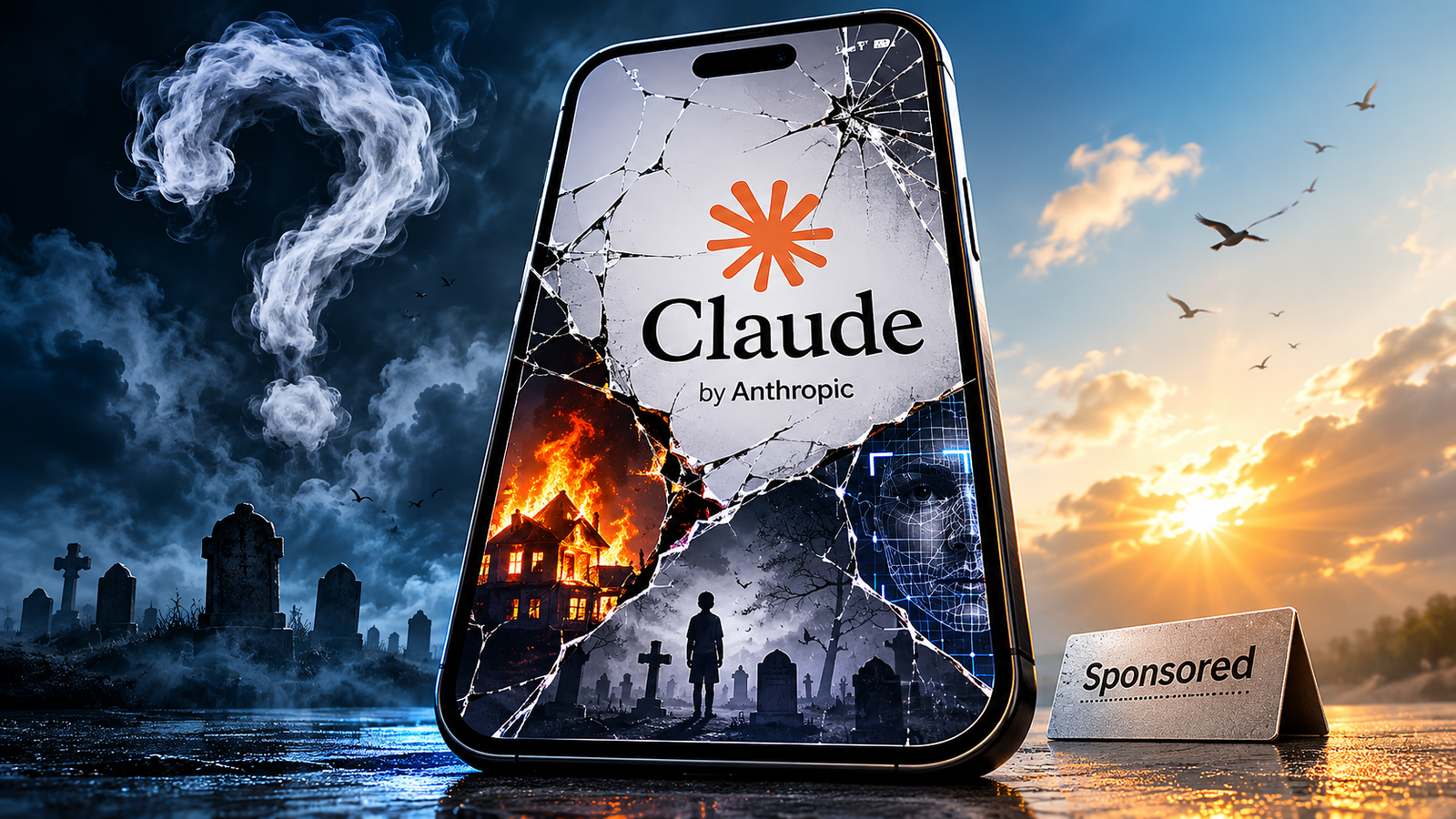
In mid-July 2026, Anthropic released a new advertisement for its Claude AI assistant titled “There’s hope in hard questions.” Within hours, it had become one of the most talked-about—and disliked—AI ads of the year.
The spot opens with a burning house, then cuts to stark stills: a crowd under facial recognition surveillance, a homeless person sleeping on the street, rows of tombstones in a cemetery, and what appears to be miners extracting raw materials for electronics. Over this, a voiceover features different people asking uneasy questions: “Can AI be trusted?” “Who’s gonna hit the brakes if we need to?”
To many viewers, it felt less like an ad for a chatbot subscription and more like a mini documentary about AI risk. Social media reactions ranged from “deeply unsettling” to “creepy” and “doomer-ist.”
This article looks at what the ad is actually doing, why it’s sparking such strong reactions, and whether Anthropic’s approach is a responsible way to talk about AI risk—or a calculated marketing play that blurs the line between ethics and branding.
What the ad shows—and what it’s selling
The ad is about 90 seconds long and deliberately bleak. It does not:
-
Show anyone happily using Claude for work or study.
-
Highlight productivity gains, writing help, or coding features.
-
Use the bright, aspirational tone common in tech advertising.
Instead, it:
-
Leads with disturbing imagery associated with AI’s potential harms: fire, surveillance, death, exploitation.
-
Voices public anxieties back to the audience: trust, control, responsibility.
-
Ends on a softer note, suggesting that asking hard questions—and building AI that can handle them—is where hope lies.
The product being sold is still a paid AI assistant: Claude, positioned as a safer, more responsible alternative to rivals. But the ad’s surface is almost entirely about risk, not utility.
Why people are calling it “creepy”
The backlash is not just about tone. Several factors are feeding the discomfort.
1) Emotional mismatch: selling a subscription with disaster visuals
Most consumers expect ads for software to be:
-
Solution-oriented: show problems, then show the product solving them.
-
Aspirational: depict better work, easier life, more creativity.
Anthropic’s ad inverts this:
-
It front-loads fear and unease, then offers a vague promise of “hope” tied to responsible AI development.
-
The leap from burning houses and cemeteries to “subscribe to Claude” feels jarring to many viewers.
For some, that mismatch reads as manipulative: using existential fears to build brand trust, rather than to drive policy change or public debate.
2) Doomer aesthetics without concrete policy
The imagery leans into familiar AI doomer tropes:
-
Loss of control (“Who’s gonna hit the brakes?”).
-
Surveillance and dehumanization (faces scanned in crowds).
-
Economic and social harms (homelessness, exploitative mining).
Critics argue that:
-
If a company truly believes AI poses such severe risks, its primary responsibility is governance, safety engineering, and transparency, not branded ads.
-
Using these visuals in a marketing campaign risks trivialising serious concerns, turning them into branding assets.
In other words: it’s one thing to publish safety research or advocate for regulation; it’s another to monetise AI anxiety in a 90-second spot.
3) A pattern of provocation
This is not Anthropic’s first controversial ad. Earlier in 2026, the company ran Super Bowl spots that mocked the idea of ads inside chatbots, clearly targeting OpenAI’s plans to introduce sponsored links in ChatGPT.
Those ads:
-
Used satire to suggest chatbots might interrupt conversations to pitch dating sites or insoles.
-
Drove a measurable surge in Claude users and intense public discussion.
-
Prompted OpenAI CEO Sam Altman to call Anthropic “dishonest” and accuse it of catering to “rich people” with higher-priced plans.
The new “hope in hard questions” campaign can be read as a continuation of this strategy:
-
Lean into controversy.
-
Position Anthropic as the adult in the room on AI risk.
-
Differentiate from rivals by seeming more serious, more cautious, more ethical.
Whether that’s responsible leadership or savvy branding depends on your view of the company’s broader conduct.
Anthropic’s broader positioning: safety as a brand
Anthropic has, from its founding, emphasised AI safety and alignment as core to its mission. It has:
-
Published research on constitutional AI and model behaviour.
-
Marketed itself as a cautious alternative to faster-moving, more commercially aggressive labs.
-
Publicly committed to not running ads inside its chatbot, contrasting itself with OpenAI’s sponsored-link experiments.
The new ad fits neatly into this narrative:
-
It acknowledges public fears rather than dismissing them.
-
It frames Anthropic as a company willing to stare directly at worst-case scenarios.
-
It implies that buying Claude is, in a small way, a vote for more responsible AI development.
From a marketing standpoint, this is coherent:
-
If your differentiator is “safety and responsibility,” then your ads should talk about risk, not just features.
-
In a crowded AI market, being the “ethical” brand can be as powerful as being the “smartest” or “cheapest.”
But coherence does not guarantee trust. For some viewers, the ad feels less like honest engagement and more like ethical signalling designed to sell subscriptions.
The counter-argument: maybe this is how responsible AI marketing should look
Supporters of the ad’s approach might argue:
-
AI is not a normal consumer product; its risks are societal and existential, not just individual.
-
Pretending otherwise—focusing only on productivity and fun—would be more dishonest than confronting uncomfortable questions.
-
If a company believes AI could cause serious harm, it has a duty to raise public awareness, even if that makes people uncomfortable.
From this perspective:
-
The ad is not “creepy”; it’s honest about the stakes.
-
The “hope” line is not a gimmick; it’s a genuine claim that careful development and hard questions can reduce risk.
-
Criticising the ad for being unsettling may reveal more about our desire to avoid difficult truths than about the ad itself.
There is also a practical point:
-
Most AI advertising so far has been glossy and optimistic.
-
A counter-narrative that forces viewers to think about control, trust, and harm could be a healthy corrective, even if it feels awkward.
The question is whether this particular execution helps or hinders that goal.
Where the ad arguably falls short
Even granting that AI risk is real and under-discussed, there are legitimate criticisms of how this ad handles the topic.
1) Vague solutions, heavy fear
The ad is strong on problems, weak on specifics:
-
It asks, “Can AI be trusted?” but does not explain what Anthropic concretely does to make Claude more trustworthy.
-
It hints at “hitting the brakes” but does not detail governance structures, red-teaming practices, or external audits.
This creates room for scepticism:
-
Is the ad primarily about raising awareness, or about associating Anthropic with seriousness without committing to measurable safeguards?
-
Could similar messages be delivered with more transparency and less aestheticised dread?
2) Emotional intensity without context
The rapid succession of disturbing images—fire, surveillance, homelessness, death, mining—can feel like a montage of global crises, loosely tied to AI.
For many viewers:
-
The link between each image and AI’s role is implied, not explained.
-
The ad risks coming across as fear-porn rather than a thoughtful exploration of specific harms.
This can backfire:
-
Instead of prompting reflection, it may trigger numbness or resentment.
-
People may reject the message not because they disagree, but because they feel emotionally manipulated.
3) Timing and competitive dynamics
The ad arrives in a period of intense rivalry:
-
OpenAI has faced backlash over ads in ChatGPT and privacy concerns.
-
Anthropic has already positioned itself as the anti-ad, pro-safety rival.
In that context, it’s hard to view the ad as purely public-spirited:
-
It reinforces a brand narrative that benefits Anthropic commercially.
-
It subtly suggests that competitors are less responsible, without naming them directly.
For some observers, that undercuts the moral high ground the ad tries to claim.
What this says about AI marketing in 2026
Anthropic’s ad is a symptom of a broader shift:
-
AI is no longer just a tech story; it’s a cultural and political story.
-
Companies are competing not only on performance and price, but on trust, ethics, and vision.
In this environment:
-
Ads will increasingly double as positioning statements about how each lab sees AI’s role in society.
-
“Safety” and “responsibility” will be used as brand attributes, just like speed or accuracy.
The risk is that:
-
Serious issues become marketing slogans.
-
Public debate is shaped more by ad campaigns than by research, regulation, or independent oversight.
The opportunity is that:
-
Thoughtful, honest communication could help the public grasp real trade-offs in AI development.
-
Companies that align their marketing with measurable practices could earn genuine trust, not just.
Anthropic’s ad sits uncomfortably between these two possibilities.
A neutral reading: what we can reasonably conclude
On the evidence available:
-
The ad is deliberately provocative and designed to stand out in a crowded landscape.
-
It reflects Anthropic’s long-standing safety-first branding, consistent with its earlier Super Bowl spots and public statements.
-
Public reaction is sharply divided: some see it as an important, honest confrontation with AI risk; others see it as creepy, manipulative, or performative.
What we cannot conclude definitively:
-
Whether Anthropic’s internal safety practices are substantially better than rivals based solely on this ad.
-
Whether the ad will increase or decrease trust in AI overall, or just in Claude.
-
How much of the creative direction came from ethical conviction versus marketing calculus—likely both.
A fair assessment is:
-
The ad succeeds in forcing conversation about AI risk and corporate responsibility.
-
It fails, for many viewers, to connect that conversation to concrete, verifiable actions by Anthropic.
-
It highlights a deeper tension in frontier-tech marketing: how to talk about real risks without sliding into fear-based branding.
For the industry—and the audience
For other AI companies, the lesson is not necessarily “don’t do this,” but:
-
If you’re going to engage with societal risks, be prepared to back it up with transparency, data, and third-party scrutiny.
-
Expect backlash if your tone feels mismatched with your product or if your actions don’t match your messaging.
For the audience:
-
It’s reasonable to be sceptical of any company that monetises the very fears it claims to be mitigating.
-
It’s also worth engaging with the substance beneath the style: What specific safeguards does Anthropic (or any lab) claim to have? How do they compare to others?
Anthropic’s “There’s hope in hard questions” ad may be unsettling by design. But the more important question is whether it leads to better-informed users, stronger safeguards, and more honest debate—or just to a memorable brand aura in an increasingly crowded AI war.