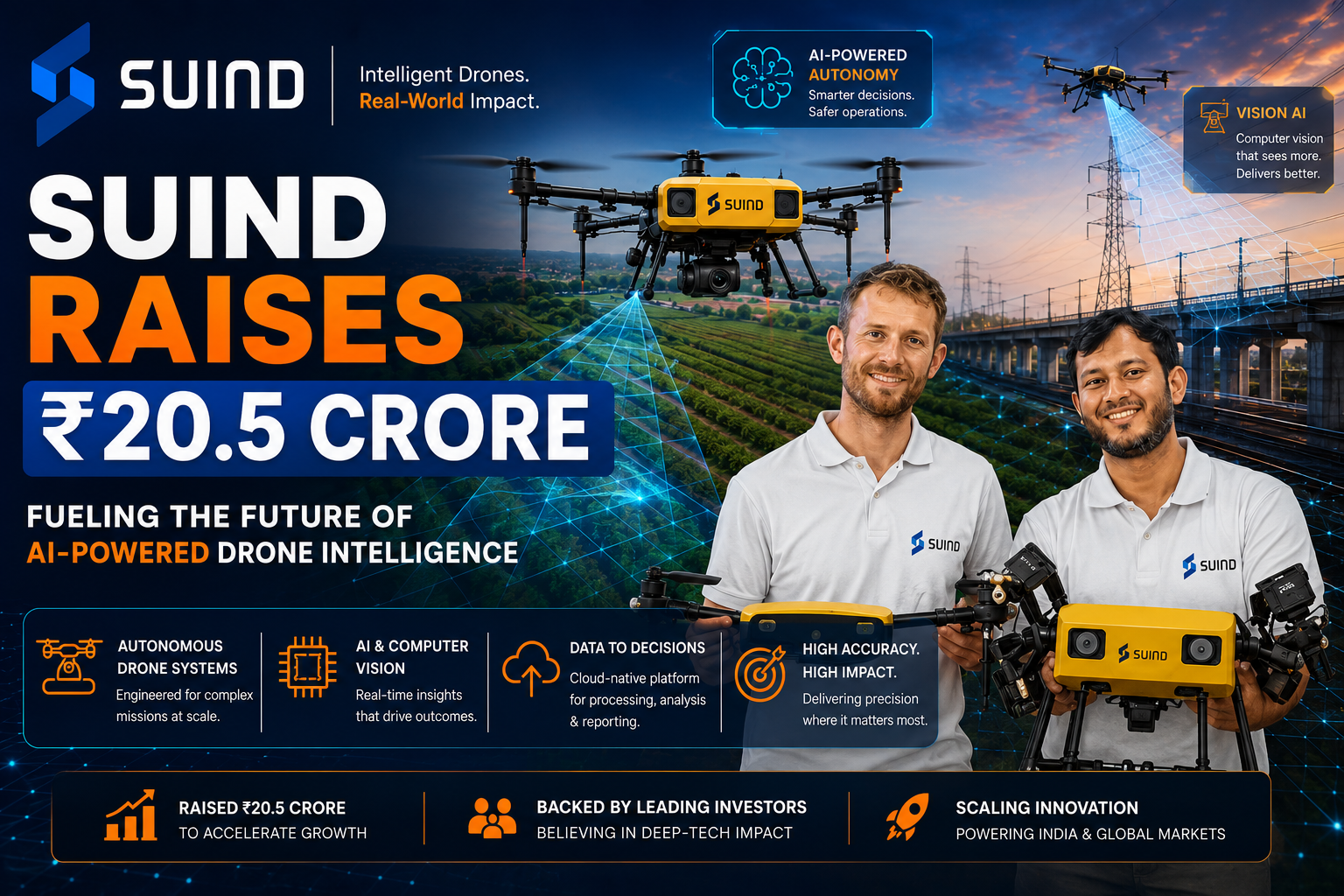
Bengaluru-based drone startup SUIND has raised ₹20.5 crore in seed funding led by Transition VC, with participation from IIMA Ventures, in a round that could help define the next phase of India’s drone-tech market. The company is using the fresh capital to scale its autonomous agriculture drones, accelerate development of its surveillance and infrastructure inspection platform, and strengthen the proprietary autonomy stack that sits at the core of its product strategy.
What makes this funding round notable is not just the amount, but the direction of the business. SUIND is not positioning itself as a drone manufacturer in the narrow sense; it is building autonomous aerial systems that can do repetitive, hazardous, and operationally complex work with minimal human dependence. That distinction matters in a market where many startups still compete on hardware deployment alone, while the more defensible opportunity lies in autonomy, navigation, and software-driven execution.
The company was founded in 2020 by Kunal Shrivastava and Kevin Kleber, and it has already commercialized its DGCA-certified agriculture spraying drone, Bumblebee. Unlike conventional drones that depend heavily on GPS, SUIND’s systems use computer vision and vision-based navigation, which allows them to operate more effectively in low-altitude and GPS-denied environments. In practical terms, that gives the startup a technological edge in use cases where precision, reliability, and environmental adaptability matter more than simple flight capability.
Its second major platform, WASP, is designed for industrial monitoring, security, surveillance, infrastructure inspection, and defence-related applications. That expansion is important because it shows SUIND is trying to move beyond the seasonal economics of agriculture into broader industrial markets with higher operational value and potentially larger recurring demand. If successful, the company could build a more diversified revenue base while also deepening its technical moat through multi-use autonomy.
The funding also arrives at a moment when India’s drone ecosystem is rapidly maturing. Precision agriculture is gaining traction, government policy support is improving, and enterprises are increasingly open to aerial automation for tasks that are expensive or dangerous to do manually. SUIND’s pitch sits directly inside that shift: use autonomy to turn drones from pilot-operated tools into intelligent systems that can observe, spray, inspect, and respond with less manual intervention.
From an industry perspective, this round signals that investors are looking past consumer-facing drone stories and into deeper infrastructure plays. Agriculture drones may be the entry point, but the real opportunity appears to be in software-defined autonomy that can be adapted across sectors. That is why the development of WASP is strategically important: it suggests SUIND wants to become a platform company, not just a single-use agri-drone vendor.
The competitive landscape is also intensifying. SUIND is operating in a market that already includes players such as Marut Drones, Garuda Aerospace, IoTechWorld Avigation, BharatRohan, and Dhaksha Unmanned Systems. In such a field, differentiation will likely come from autonomy depth, certification readiness, field reliability, and the ability to move from pilots to scaled deployment. Capital helps, but execution will determine whether SUIND becomes a category leader or just another well-funded participant.
The company says it will use the next 12 to 24 months to expand manufacturing and deployment of Bumblebee while preparing WASP for commercial launch. That timeline suggests the startup is now entering a critical phase where product maturity, customer adoption, and operational scale will need to converge. In drone tech, especially in India, that is often where the gap between innovation and durable business value becomes most visible.
Why it matters
SUIND’s raise is important because it reflects the industry’s transition from drones as machines to drones as autonomous systems. If the company can prove that its vision-based autonomy works reliably at scale, it could help shape how India thinks about drones in agriculture, industrial safety, and surveillance. More broadly, the round shows that investors are willing to back deep-tech drone companies that are building for the long game rather than chasing short-term hardware sales.