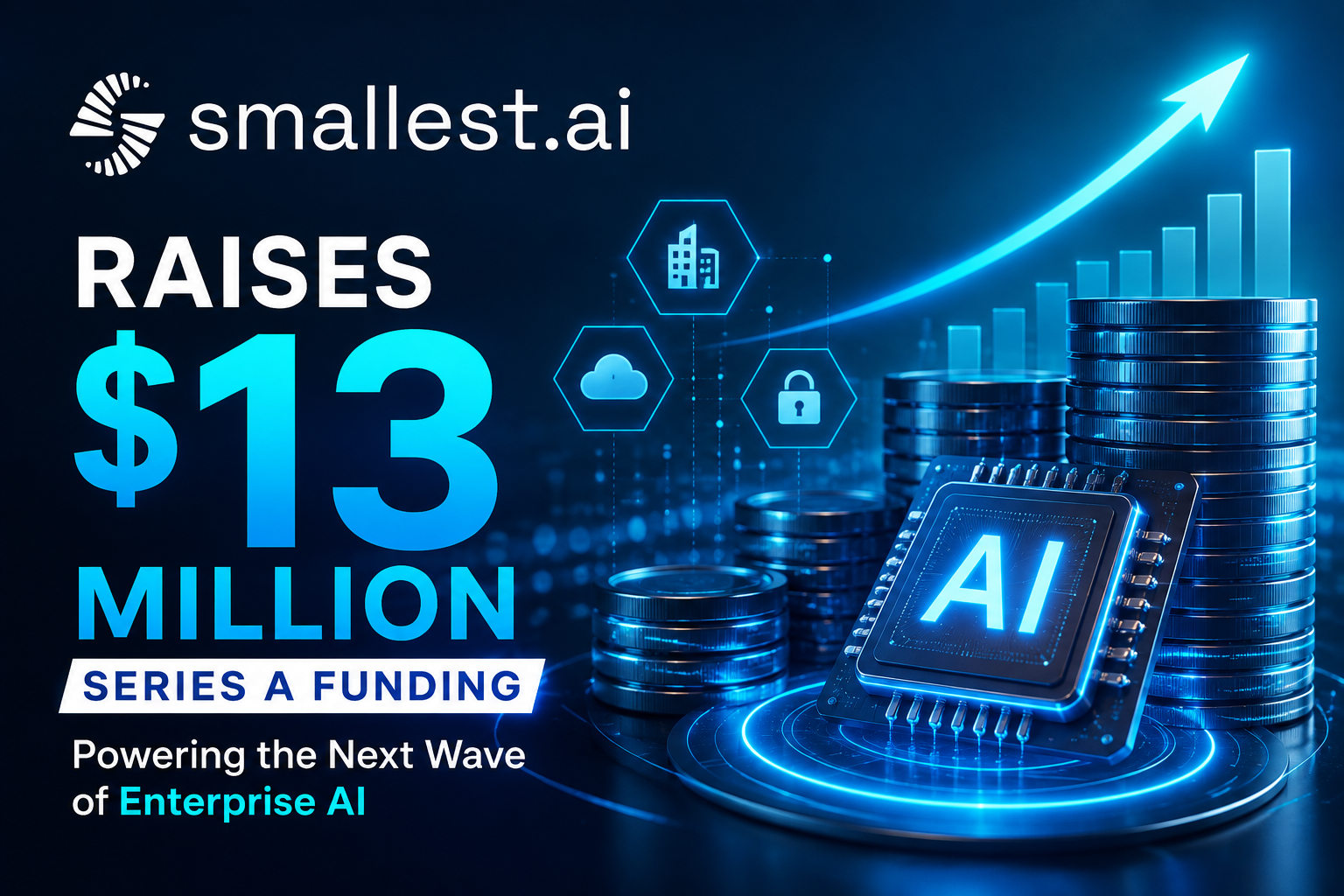
Smallest.ai’s $13 million Series A is a strong signal that investors are increasingly serious about enterprise voice AI. Led by Seligman Ventures, with participation from Sierra Ventures and 3one4 Capital, the round takes the company’s total funding past \$21 million and gives it more room to scale both product and go-to-market.
What makes Smallest.ai interesting is not just that it builds the voice AI, but that it is trying to solve one of the hardest problems in the category: making AI conversations sound and feel truly real. The company is building for speed, low latency, and human-like interaction, which matters in high-volume enterprise settings where every pause or awkward response hurts user trust.
Why investors care
The core investment case is simple. Enterprise voice is still underserved by systems that are reliable enough for production but natural enough for customers to actually enjoy using. Smallest.ai believes the answer is not bigger models, but better architecture — specifically a parallel, real-time system that can listen, think, and respond without the lag that makes many voice bots feel robotic.
That thesis is attractive because it targets a real business pain point. Contact centers, financial services, healthcare, BPO, and customer support teams all want automation, but they cannot afford poor conversation quality, compliance issues, or latency. If Smallest.ai can consistently improve those metrics, it could become infrastructure rather than just another app-layer AI startup.
The founders and product vision
Smallest.ai was founded by Sudarshan Kamath and Akshat Mandloi in 2023. The company began as an AI research lab, and its current pitch reflects that technical DNA: build compact, efficient voice models that outperform slower, heavier systems in real-time conversations.
Its latest platform, Voice 4.0, is built around Hydra, an asynchronous speech-to-speech architecture. In plain terms, the company is trying to make AI voice agents handle interruptions, tool use, and natural turn-taking more like humans do, instead of speaking in rigid, delayed steps.
The investor mix
Seligman Ventures led the round, while Sierra Ventures and 3one4 Capital joined as participants. Smallest.ai also highlighted support from Better Capital, Upsparks Capital, Schema Ventures, Tiny VC, DeVC, Mission Street Capital, and a group of angels.
That mix is notable because it combines deep-tech conviction with enterprise software experience. Seligman’s AI and infrastructure focus fits Smallest.ai’s technical story, while Sierra and 3one4 bring early-stage backing and familiarity with enterprise and India-linked startup ecosystems.
Why the round matters
This is a meaningful round because it shows that voice AI is moving beyond novelty. Investors are backing companies that can prove real business value, especially in customer-facing workflows where speed, accuracy, and natural speech directly affect revenue and cost.
Smallest.ai is still early, but it already has enterprise customers such as RingCentral and Truecaller, which gives the company more credibility than a pure prototype-stage startup. For investors, that combination of technical ambition and early customer traction is exactly what makes the round interesting.
Bottom line
Smallest.ai looks like a focused, technically driven bet on a very large market. The company is not trying to win by being broad; it is trying to win by making enterprise voice AI fast enough, natural enough, and reliable enough to become part of everyday business operations.