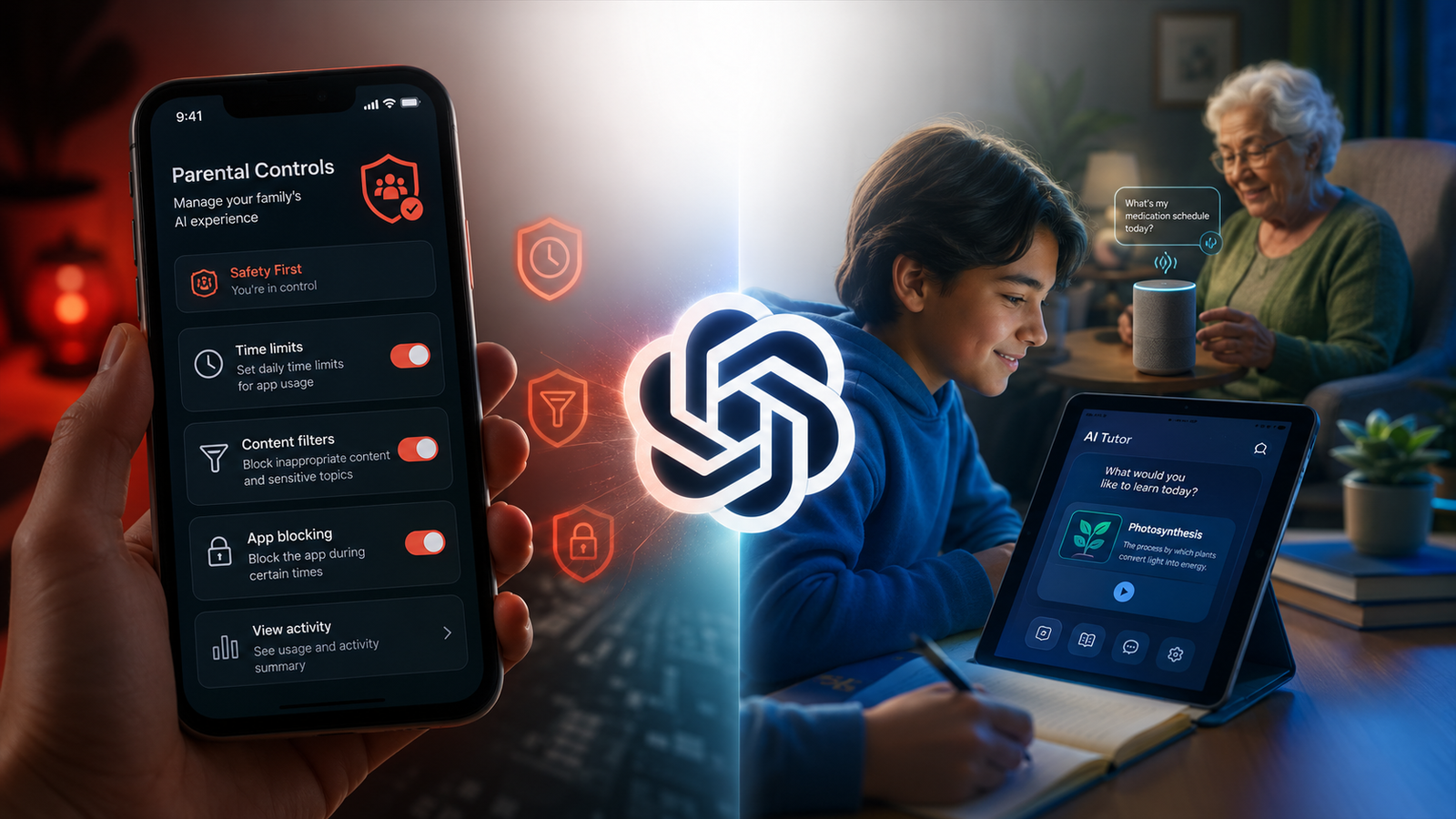
OpenAI is quietly shifting ChatGPT from a productivity tool for individuals and companies into a household-level technology, with dedicated product work for families, caregivers, and older adults.
This move has clear implications for how AI will be sold, regulated, and used—not just in the US, but in markets like India, where families are central economic and social units, and where enterprise AI adoption is accelerating.
This analysis breaks down what’s happening, why it matters, and how it could reshape enterprise strategies and the Indian market—without hype or panic.
What’s actually changing?
OpenAI is:
-
Hiring a dedicated product manager in San Francisco to build experiences for families, caregivers, and older adults across its products.
-
Expanding safety features aimed at younger and more vulnerable users:
-
Parental controls for teen accounts.
-
Routing sensitive conversations to reasoning models better at handling distress.
-
An optional “Trusted Contact” feature that can alert a family member or caregiver in potential self-harm cases.
-
This comes as ChatGPT’s user base visibly ages and broadens:
-
Globally, the share of users aged 35+ rose to 31% in Q2 2026, from 26% a year earlier; the 18–24 segment fell to 29% from 34%.
-
In the US, nearly 1 in 4 smartphone users who are parents used ChatGPT in Q2, up from 16% a year earlier.
-
Among US parents, Gemini leads at 32% reach, ChatGPT is at 24%, Claude at 4%, Copilot at 2%.
In other words: ChatGPT is no longer just a tool for students, developers, and early adopters. It’s becoming a family-shared technology, used by parents, teens, and increasingly older adults.
As Ben Bajarin of Creative Strategies puts it, this mirrors the path of Google, Apple, and Meta, whose platforms moved from individual tools to household infrastructure—but with AI, “the assistant is not just mediating content or devices,” it’s actively shaping decisions, learning, and behavior.
Why families matter to OpenAI’s business model
There are three strategic reasons behind this shift:
1) Expanding the revenue base beyond enterprise
OpenAI has already built a strong enterprise story:
-
More than 1 million business customers globally.
-
Over 7 million ChatGPT for Work seats, with Enterprise seats up 9x year-over-year.
-
Reported 75% of enterprises seeing positive ROI from AI deployments.
But enterprise sales cycles are long, procurement is complex, and competition with Microsoft, Google, and Anthropic is intensifying. Consumer and family-oriented products offer:
-
Faster adoption: households can subscribe without RFPs or IT approvals.
-
Higher lifetime value: family plans, multi-user subscriptions, add-ons for education, tutoring, caregiving.
-
Cross-sell opportunities: parents using ChatGPT at home are more likely to push for it at work, and vice versa.
A family-focused strategy effectively turns ChatGPT into something closer to a utility—like electricity or broadband—embedded in daily life, not just office workflows.
2) Pre-empting regulation and reputational risk
OpenAI has faced multiple lawsuits from parents alleging that ChatGPT contributed to harm suffered by their children, including in suicide-related cases.
At the same time, research shows a gap between parental perception and reality:
-
Only 27% of US parents said their child used generative AI in the past week, while 38% of children reported doing so.
By creating family-specific product roles, controls, and safeguards, OpenAI is:
-
Signaling responsibility to regulators and courts.
-
Building a defensible position: “We designed these features with children and families in mind.”
-
Trying to avoid repeating social media’s mistake of treating kids like adults and scrambling later.
Stephen Balkam of the Family Online Safety Institute calls this “safety by redesign”: building age-appropriate experiences, stronger content controls, parental oversight, and clear disclosures that users are interacting with AI, not a human.
3) Locking in the next generation of users
Children and teens who grow up with ChatGPT as a tutor, homework helper, and career advisor are likely to:
-
Remain loyal to the platform as they enter college and the workforce.
-
Influence their parents’ choices (which AI to use, which devices to buy).
-
Shape organizational norms when they become decision-makers.
For OpenAI, investing in families today is a long-term bet on brand loyalty, network effects, and data advantages that compound over decades, not just quarters.
What this means for enterprises globally
For businesses, OpenAI’s family push is not a side story; it changes the context in which enterprise AI will be adopted and governed.
1) Blurring boundaries between work and home AI use
Employees are already using ChatGPT at home for:
-
Homework help for their children.
-
Personal finance, health queries, and career advice.
-
Side projects, content creation, and small-business tasks.
When the same tool is used at home and work, several things happen:
-
Shadow AI usage rises: employees bring habits, prompts, and expectations from home into the workplace, sometimes bypassing official tools.
-
Security and data policies get stress-tested: if a family plan allows certain features but the enterprise plan restricts them, users may try to work around controls.
-
Training and change management become more important: companies must educate staff not just on “how to use AI at work,” but on how home usage differs and what not to bring into corporate environments.
Enterprises will need clearer acceptable-use policies that explicitly cover personal/family AI tools and their interaction with work systems.
2) Rising expectations for safety, transparency, and control
As parents experience parental controls, usage limits, and safety dashboards at home, they’ll expect similar rigor at work:
-
Clear visibility into what data AI systems see and store.
-
Granular controls over which models, features, and integrations are enabled.
-
Audit trails and reporting not just for compliance teams, but for managers and end users.
Vendors that offer enterprise-grade governance with consumer-grade UX will have an edge.
3) New product and service opportunities
The family layer creates new B2B opportunities:
-
EdTech and upskilling: companies can integrate ChatGPT-based tutoring, homework help, and career guidance into employee benefits or customer offerings.
-
Healthcare and wellness: AI assistants for caregivers and older adults can be bundled with health platforms, insurance products, and telemedicine services.
-
Financial services: family-oriented AI for budgeting, investing education, and fraud awareness can become a differentiator for banks and fintechs.
In India particularly, where family-centric financial and education decisions are the norm, this opens specific product lines that blend B2C and B2B models.
4) Competitive dynamics with Microsoft, Google, and Anthropic
OpenAI’s consumer and family strategy interacts with its enterprise relationships:
-
Microsoft already sells AI to businesses via Azure OpenAI Service and Copilot, which skews older and more enterprise-focused.
-
Google has Gemini widely used among parents (32% of US parents), plus deep integration with Android, Search, and Workspace.
-
Anthropic’s Claude is strong among 25–34-year-olds andknowledge workers but has less parent penetration.
Enterprises evaluating AI stacks will now consider:
-
Which vendor has strongest consumer and family adoption among their employees and customers.
-
How easily consumer and enterprise accounts can be managed under unified governance.
-
Whether family-oriented features (tutoring, eldercare support) can be leveraged as employee benefits or customer value-adds.
The Indian angle: why this matters more here than in many markets
India is not just another market for this shift. Several structural factors make OpenAI’s family push particularly consequential here.
1) Family as the core economic and social unit
In India:
-
Financial decisions (investments, insurance, loans) are often joint family decisions.
-
Education choices for children are high-priority household spending.
-
Elder care is still largely family-managed, with growing reliance on digital tools.
An AI assistant that positions itself as useful for:
-
Homework help, exam prep, career guidance
-
Health and caregiving advice
-
Household budgeting, bill management, fraud awareness
can embed itself deeply into Indian households faster than in more individualistic markets.
Already, Indian parents are among the most active users of edtech, online tutoring, and learning apps. A ChatGPT-like tool that offers multilingual, affordable, always-on tutoring and guidance could see rapid adoption, especially in Tier 2 and Tier 3 cities where access to high-quality human tutors is limited.
2) Enterprise AI adoption is accelerating, but uneven
India is one of the fastest-growing markets for enterprise AI:
-
Indian IT services firms, startups, and large corporates are aggressively piloting and deploying AI in customer support, software development, finance, and operations.
-
At the same time, many SMEs and traditional businesses are still in early stages, with concerns around cost, skills, and data security.
OpenAI’s dual push—enterprise + family—creates two entry points:
-
Top-down: CIOs and business leaders adopting ChatGPT Enterprise or API-based solutions for workflows.
-
Bottom-up: employees and founders already using ChatGPT at home, then pushing for formal adoption at work.
In India’s often informal, relationship-driven business culture, bottom-up pressure from employees and family networks can be a powerful adoption driver.
3) Language, accessibility, and the “first AI” generation
For many Indians, especially in non-metro areas, ChatGPT and similar tools may become their first serious exposure to advanced AI, before they ever interact with enterprise systems.
Key factors:
-
Multilingual support: If ChatGPT and competitors deepen support for Hindi, Tamil, Telugu, Bengali, Marathi, etc., they can become default assistants for students, small traders, and first-time internet users.
-
Low-friction access: A smartphone + data plan is often enough; no need for expensive laptops or enterprise software.
-
Aspirational value: Using AI for exam prep, English practice, or job applications carries strong aspirational appeal.
For enterprises, this means:
-
Future employees will arrive with AI-native habits and expectations.
-
Customer-facing AI (support bots, sales assistants, financial advisors) will be judged against consumer-grade AI experiences people use at home.
-
Companies that ignore this “first AI” generation risk building products that feel clunky, paternalistic, or outdated.
4) Regulatory and policy environment in India
India’s approach to AI is still forming, but several signals are clear:
-
Strong focus on safety, misuse, and harm reduction, especially for children and vulnerable groups.
-
Growing scrutiny of data privacy, cross-border data flows, and platform accountability.
-
Interest in using AI for public good: education, health, agriculture, governance.
OpenAI’s family-focused safety features—parental controls, trusted contacts, distress-handling models—could be viewed positively by Indian regulators if:
-
They are transparently implemented and locally adaptable.
-
They align with emerging child protection and data protection norms.
But there are risks:
-
If high-profile incidents of AI-related harm involving Indian children emerge, pressure could mount for stricter local controls or even usage restrictions.
-
If family features are perceived as culturally insensitive (e.g., around mental health, relationships, or religious content), backlash could affect brand trust.
For Indian enterprises, this means:
-
Vetting AI vendors not just on technical capabilities, but on safety design, localisation, and regulatory posture.
-
Building internal policies that anticipate future regulation around AI use by minors and in sensitive domains.
5) Opportunities for Indian startups and IT services
OpenAI’s household strategy creates multiple opportunity buckets for Indian players:
EdTech and learning
-
Startups can build ChatGPT-powered tutors, test-prep assistants, and career counselors tailored to Indian curricula (CBSE, ICSE, state boards) and competitive exams (JEE, NEET, UPSC).
-
Existing edtech firms can integrate AI tutors to reduce costs, personalise learning, and scale beyond metros.
BFSI and fintech
-
Banks and fintechs can offer AI financial coaches for households: budgeting, goal-based savings, basic investing education, fraud detection.
-
Insurance companies can use AI to explain policies, guide claims, and support eldercare planning in local languages.
Healthcare and eldercare
-
Health-tech platforms can integrate AI assistants for symptom triage, medication reminders, and caregiver guidance, especially for aging parents in nuclear families.
-
Telemedicine providers can use AI to pre-screen patients, summarize histories, and follow up in regional languages.
IT services and consulting
-
Indian IT firms can build industry-specific AI layers on top of OpenAI’s models: for retail, manufacturing, logistics, with family-aware features (e.g., workforce upskilling tied to household learning plans).
-
Consulting practices can help clients design AI governance frameworks that cover both enterprise and employee/family usage.
Risks and tensions to watch
This family-centric vision is not without significant challenges.
1) Safety vs. utility trade-offs
Tighter controls for children and vulnerable users can:
-
Reduce exposure to harmful content.
-
But also limit creative exploration, advanced learning, and legitimate use cases (e.g., mental health information, sexuality education, career exploration).
Striking the right balance will require:
-
Age-appropriate tiers, not one-size-fits-all restrictions.
-
Clear, understandable explanations to parents and teens about what is restricted and why.
2) Inequality and access gaps
In India and many other markets:
-
Affluent, urban families will get early access to premium AI tutors, caregivers, and productivity tools.
-
Lower-income households may rely on free or ad-supported versions, with weaker safeguards and more bias.
This could widen existing gaps in:
-
Education quality.
-
Digital literacy.
-
Career opportunities.
Enterprises and policymakers need to consider how to avoid a future where AI advantages compound existing inequalities.
3) Cultural and ethical sensitivities
AI assistants advising on:
-
Career choices, relationships, mental health, and religion
-
Family finances and intergenerational decisions
will inevitably run into cultural nuances that global models may not fully grasp. Risks include:
-
Advice that clashes with local norms or values.
-
Misinterpretation of context (e.g., family conflict, gender roles, caste dynamics).
-
Over-reliance on AI for decisions that traditionally involve elders, teachers, or community leaders.
Localisation isn’t just about language; it’s about contextual understanding and ethical alignment.
4) Data privacy and surveillance concerns
Family-oriented AI implies:
-
Shared accounts or linked profiles.
-
Household memory and context across devices.
-
Caregiver access to certain data in distress scenarios.
This raises questions:
-
Who owns and controls this data?
-
How is it protected from misuse (by platforms, hackers, or even family members)?
-
What happens in cases of domestic abuse, coercive control, or surveillance within families?
In India, where data protection law is still maturing, these issues could become flashpoints if not handled carefully.
Strategic takeaways for decision-makers
For enterprise leaders (including in India)
-
Treat AI as a household technology, not just an office tool. Update policies to cover personal and family usage by employees.
-
Invest in AI literacy programs that help staff distinguish between safe home use and risky work use.
-
When selecting AI vendors, evaluate:
-
Safety and parental-control features.
-
Localisation and multilingual support.
-
Governance, auditability, and compliance posture in India.
-
For product managers and founders
-
Think beyond “user” to “family unit”: design for parents, teens, elders, and caregivers, not just individuals.
-
Build age-appropriate, role-based experiences with clear boundaries and controls.
-
For India, prioritize:
-
Multilingual interfaces.
-
Low-bandwidth, mobile-first designs.
-
Content aligned with local curricula, exam systems, and cultural contexts.
-
For policymakers and regulators
-
Encourage safety-by-design without stifling innovation: focus on transparency, age-appropriate design codes, and clear accountability.
-
Support research on AI’s impact on children, families, and mental health in the Indian context.
-
Promote public-interest AI in education, health, and skilling, leveraging family-oriented capabilities for social good.
The bigger picture: AI as household infrastructure
OpenAI’s move to bet on families is a signal that generative AI is entering a new phase:
-
From novelty tool → productivity assistant → household infrastructure.
In this world:
-
AI is present at the dinner table, the study desk, the elder’s bedside, and the office desk.
-
Decisions about education, health, money, and careers are increasingly co-authored with AI.
-
Enterprises must design not just for workers, but for workers-as-parents, children, and caregivers.
For India, this shift could be transformative:
-
Potentially democratizing access to high-quality tutoring, guidance, and support.
-
But also risking new forms of inequality, dependency, and cultural friction if not steered carefully.
The companies and policymakers that understand this household layer—and design for it responsibly—will shape the next decade of AI’s impact far more than those that see AI only as an enterprise software category.