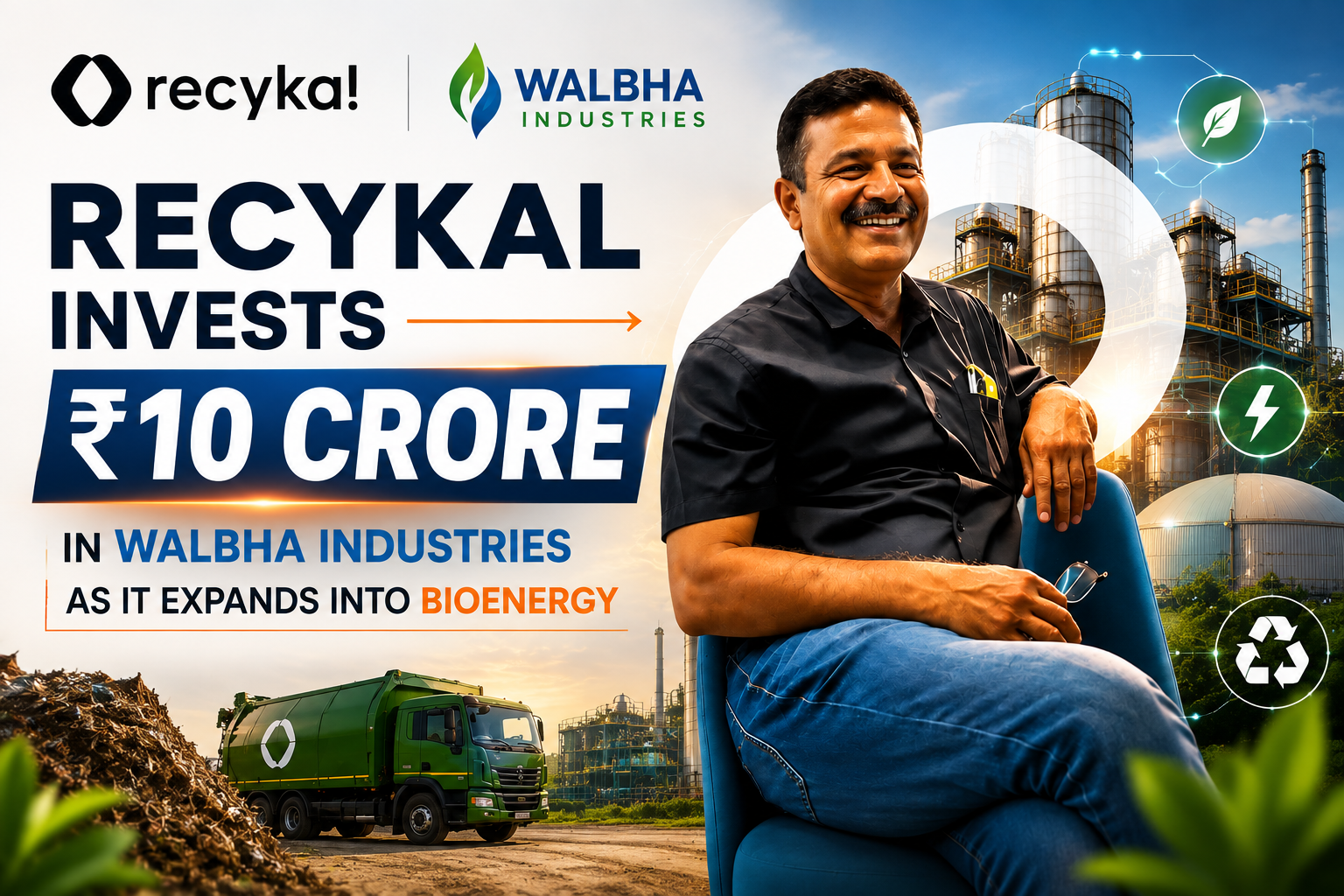
Recykal’s ₹10 crore investment in biomass fuel manufacturer Walbha Industries is more than an adjacent bet. It is a clear signal that the Hyderabad-based circular economy company wants to move from waste management into the broader bioenergy value chain, linking agricultural residue, industrial fuel, and circular commerce into one connected business model.
The deal gives Recykal a direct entry into biomass briquettes and pellets, a segment that is gaining relevance as Indian industry looks for cleaner alternatives to coal and other fossil-based fuels. Walbha’s business is built around converting agricultural residue such as groundnut shells, mustard husk, and sawdust into usable fuel, which fits neatly with Recykal’s long-standing mission of turning waste streams into economic value.
Recykal was founded by Abhay Deshpande, Abhishek Deshpande, Anirudha Jalan, and Ekta Narain, with some company profiles also listing other early team members. The company began as a waste-tech platform and has since evolved into a broader circular economy infrastructure player, offering digital marketplace tools, EPR solutions, and systems that connect brands, recyclers, and waste aggregators.
The Walbha investment adds a new layer to that evolution. Instead of stopping at waste collection and traceability, Recykal is now backing a business that monetizes agricultural residue through industrial fuel. That move can create a stronger loop in the circular economy, where waste is not only diverted from landfills but also turned into a commercially viable energy source.
Walbha’s operating profile makes the partnership strategically interesting. The company manufactures biomass briquettes and pellets, operates a production facility in Jhansi, and sources raw material through a large farmer-linked network. By connecting Walbha’s output with Recykal’s enterprise ecosystem, the partnership could improve procurement, market access, and logistics for biomass buyers across India.
The investment also shows how climate-tech companies are expanding from software and marketplaces into physical infrastructure. Recykal already has a strong footprint in waste-commerce and has raised multiple rounds over the years, including a pre-Series B round in 2024 and a more recent bridge round in 2026. Backing Walbha suggests that the company is now willing to place capital into adjacent operating assets that can strengthen its long-term platform value.
That approach matters because the bioenergy market in India still faces challenges around quality consistency, distribution, and demand aggregation. If Recykal can help solve those problems by combining digital systems with supply-side control, it could make biomass fuel easier for industrial users to adopt at scale. In that sense, the Walbha deal is not just a strategic investment; it is a test case for whether circular economy platforms can become real energy infrastructure businesses.
The bigger industry implication is that Indian sustainability startups are beginning to connect the dots between waste, fuel, and industrial demand. Recykal’s move suggests the next phase of circularity may not be limited to recycling alone, but may extend into the creation of new clean-energy supply chains built on what was once discarded.
Why it matters
This deal shows Recykal broadening its thesis from waste recovery to energy transition. If successful, it could strengthen the case for circular economy companies to enter capital-intensive sectors where physical supply chains and digital coordination work together to create durable value.