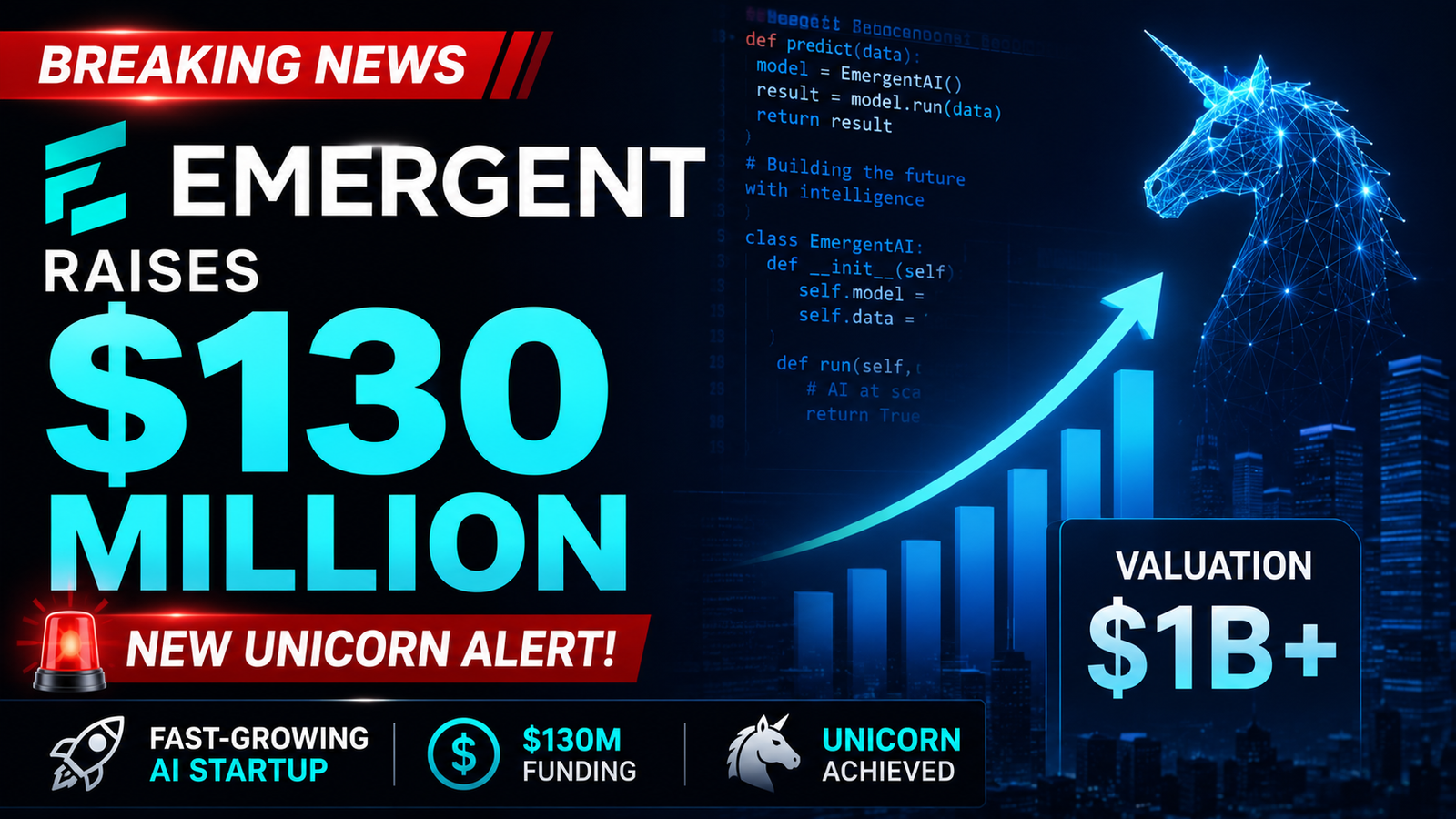
Emergent’s latest $130 million Series C is more than just another big AI round. It shows how quickly investor confidence can build around startups that combine strong growth, a clear product story, and early revenue traction. The Bengaluru- and San Francisco-based company has moved from launch to unicorn status in just over a year, making it one of the sharpest valuation climbs in India’s current startup cycle.
What makes the round notable is not only the size, but also the speed. Emergent reportedly went from a $300 million valuation in January to $1.5 billion by July, with total funding now around $230 million. That kind of jump suggests investors are no longer treating AI coding tools as experimental side bets; they are increasingly viewing them as serious infrastructure for the next generation of software creation.
A fast-moving business model
Emergent is part of the “vibe coding” wave, where users can build software through natural-language prompts rather than traditional programming. The appeal is broad because it opens software creation to founders, small businesses, and non-technical users who would otherwise need engineering teams. That wider addressable market is one reason the company has been able to scale so quickly.
The startup says it has reached a $120 million annualized revenue run rate and has more than 200,000 paying customers. Those numbers matter because they give the company a stronger commercial foundation than many AI startups that are still pre-revenue or dependent mainly on product hype. In a market where valuations can move faster than fundamentals, Emergent’s revenue claims help explain why investors were willing to re-rate it so aggressively.
What the round says about India
This funding also says something broader about India’s AI ecosystem. Emergent is being positioned as part of a new class of Indian startups building global AI products, not just local-market tools or enterprise services. Its rapid rise suggests Indian founders can now compete in categories that are attracting global capital and global attention at the same time.
That matters because India has often been seen as a strong talent market but a slower place for deep-tech scaleups to emerge. Emergent challenges that perception by showing that an Indian-founded company can go from launch to unicorn in a short period if the product fits a fast-growing need. It may also encourage more venture capital to flow into AI-native software startups from India, especially those aimed at international markets.
Investor signal and market pressure
The investor lineup is another reason the round stands out. Creaegis led the Series C, while Khosla Ventures, SoftBank Vision Fund 2, Lightspeed, Y Combinator, and others joined in. When firms with that profile keep backing a company at multiple stages, it tends to send a strong signal to the rest of the market that the growth story is worth watching.
But fast funding also creates pressure. A company that rises this quickly has to keep proving it can sustain demand, retain users, and turn attention into durable market share. The AI coding segment is becoming more crowded, and as more tools chase the same user base, differentiation will matter just as much as speed. Emergent’s next challenge is not just to stay ahead in fundraising, but to keep its product sticky enough to justify the valuation.
Market impact ahead
For the broader market, Emergent’s funding could have three effects. It may push more investors to look at AI software creation as a category with real commercial upside, especially if platforms can monetize small businesses and non-technical users. It may also intensify competition among startup builders, no-code tools, and AI-assisted development platforms trying to capture the same demand.
The third effect is reputational: a win like this gives Indian AI startups more visibility in global conversations about software development. If Emergent continues to grow, it could become a benchmark for how quickly an AI-native product can scale from India into a global business. That would make this funding round important not just for the company, but for the direction of the Indian startup market as a whole.
Why readers should care
Emergent’s rise shows how quickly AI can reshape startup economics when the product hits a real pain point. It also suggests that the next wave of software companies may be judged less by code complexity and more by how effectively they let ordinary users build, deploy, and automate. In that sense, this funding is not only about one startup’s valuation; it is also a sign of where the market may be heading next.