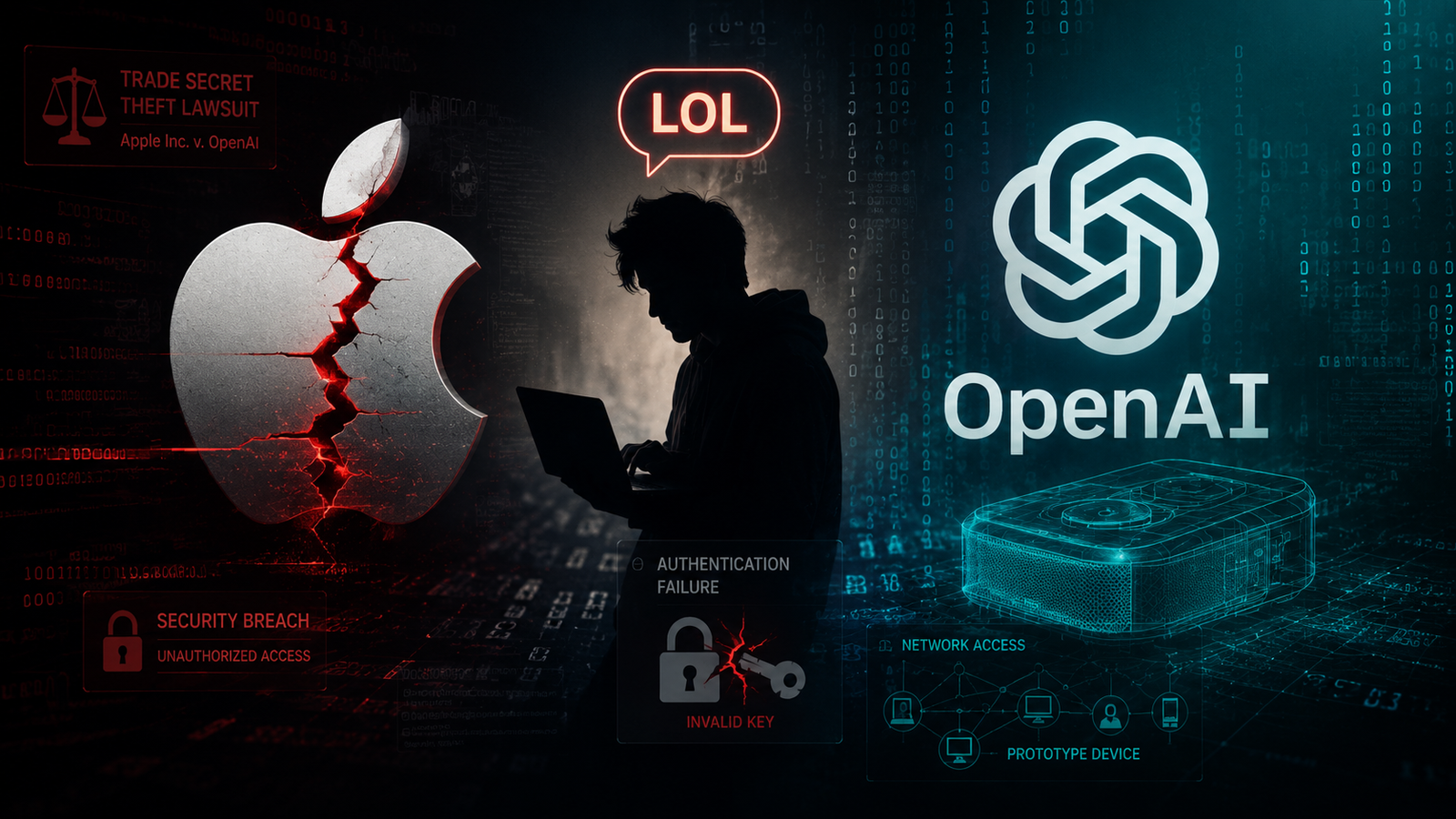
A zero-day bug, a company laptop, and a message that read ‘LOL’—how one ex-Apple engineer became the flashpoint in a widening war over AI talent and hardware secrets.
In early July 2026, Apple filed a bombshell lawsuit in a California federal court alleging that OpenAI systematically stole Apple trade secrets to jump-start its nascent hardware business.
At the center of the complaint is a striking detail: a former Apple system electrical engineer, Chang Liu, who joined OpenAI in January 2026 and, weeks later, allegedly exploited a rare, previously unknown authentication bug to keep accessing Apple’s internal network and download dozens of confidential hardware files while employed at OpenAI.[
Apple says Liu celebrated the discovery with a message to a colleague—“LOL”—before methodically pulling unreleased product specs, engineering presentations, and proprietary project data from Apple’s shared folders.
This article unpacks what Apple is alleging, how the technical breach likely worked, why this matters beyond one employee, and what it signals about the escalating AI talent and hardware wars.
The core allegations: what Apple says happened
Apple’s complaint, filed in the U.S. District Court for the Northern District of California, names OpenAI, its hardware subsidiary io Products, and two former Apple employees now at OpenAI:
-
Chang Liu, a senior system electrical engineer who left Apple in January 2026.
-
Tang Yew Tan, a 24-year Apple veteran who is now OpenAI’s chief hardware officer.
Chang Liu and the “zero-day” authentication bug
According to Apple:
-
Liu left Apple in January 2026 to join OpenAI, but did not return his Apple-issued work laptop and did not schedule an exit interview.
-
In February 2026, while already working at OpenAI, Liu tried to access Apple’s network storage—a cloud-based repository containing confidential engineering files, project documentation, and proprietary data.[
-
He discovered he could still log in due to a then-unknown authentication vulnerability—a zero-day bug in Apple’s access-control system.
-
Using this bug, Liu allegedly downloaded “dozens of Apple’s confidential hardware-related files” over several weeks, including:
-
Detailed information about unreleased products
-
Engineering presentations
-
Technical specifications
-
Proprietary project data
-
Apple’s internal investigation, based on server logs, concluded that “only Liu exploited the bug to steal Apple’s confidential information”, though the bug could theoretically have allowed a “few other” people to access data.
Once Apple became aware of the breach, it:
-
Fixed the bug.
-
Terminated Liu’s access to its network.
Apple also points to a message in which Liu allegedly told a colleague something along the lines of “LOL, I can access it” upon realizing the bug still granted him entry—framing the incident not as an accidental oversight but as a deliberate, even gleeful, exploitation.
Tang Yew Tan and the broader “pattern of theft”
Apple’s allegations go well beyond Liu. The complaint describes a broader pattern of trade-secret misappropriation tied to OpenAI’s recruitment of Apple staff:
-
Tang Yew Tan, before leaving Apple, allegedly emailed himself information about Apple hardware suppliers and internal industry summaries.
-
After moving to OpenAI, he is accused of using that knowledge to benefit OpenAI’s hardware efforts, including leveraging supplier relationships and internal Apple strategies.
-
Apple claims OpenAI recruiters and interviewers:
-
Told candidates to study confidential Apple documents and prepare “Technical Deep Dive” presentations on their Apple work.
-
Asked some candidates to bring actual Apple parts (batteries, logic boards, glass samples) to interviews for “show and tell” sessions.
-
Used secret Apple code names in interviews and probed for details about vendors, suppliers, and engineering strategies.
-
Apple’s filing uses pointed language:
“OpenAI has been stealing Apple’s trade secrets and confidential information. As a natural result, OpenAI’s nascent hardware business now rests on the shakiest of foundations, rotten to its core by its illegal reliance on misappropriated trade secrets.”
The company also claims it found incriminating messages on workers’ company-issued laptops and alleges that OpenAI advised departing employees on how to evade Apple’s forensic and security checks, including skipping two-week notices and avoiding exit interviews.
The technical story: how such a breach could happen
While Apple has not released a full technical advisory, the complaint and reporting sketch a plausible chain of events that security teams will recognize as a textbook insider threat + zero-day access control failure.
1) The asset: a still-active company laptop
Key facts from Apple’s complaint:
-
Liu retained his Apple-issued laptop after leaving.
-
That device had previously been used to access Apple’s internal network and shared folders.
In many large tech firms, offboarding procedures include:
-
Revoking all credentials (SSO, VPN, MFA devices).
-
Wiping or reclaiming devices.
-
Disabling directory accounts and API tokens.
If any of these steps are missed—or if a device retains cached credentials or session tokens—it can become a persistent foothold for ex-employees.
2) The bug: an authentication vulnerability (zero-day)
Apple describes the flaw as:
-
A “rare, previously unknown authentication bug”.
-
A zero-day vulnerability, meaning Apple had no prior knowledge and no patch ready when it was exploited.
In practical terms, this likely means:
-
The system’s logic for checking whether a user is still employed or authorized failed under certain conditions.
-
Possibly, the authentication flow relied on:
-
A stale session token that wasn’t invalidated on offboarding.
-
A directory sync delay where the user’s “active” status wasn’t updated in time.
-
A misconfigured SSO or MFA rule that allowed access from a known device or IP range even after employment ended.
-
Security researchers often call these “logic bugs” in identity and access management (IAM): not a classic buffer overflow, but a flaw in business logic that says, “This user should no longer have access”—which the system incorrectly ignores.
3) The exfiltration: shared folders and server logs
Apple’s internal systems apparently:
-
Logged each access and download event.
-
Showed that Liu accessed network storage in February 2026—weeks after leaving.
-
Contained evidence that he downloaded dozens of hardware-related files.
This suggests:
-
Centralized file repositories (e.g., internal “shared drives”) with broad engineering access.
-
Sufficient logging to reconstruct who accessed what and when—critical for forensic investigations and legal proceedings.
The fact that Apple could pinpoint one individual’s exploitation of the bug indicates relatively mature logging and monitoring, even if the initial access control failed.
The bigger picture: talent wars, hardware ambitions, and AI
This case is not just about one bug or one engineer. It sits at the intersection of three major trends:
1) The AI talent war has gone nuclear
Apple’s complaint alleges that more than 400 former Apple employees are now at OpenAI, and that the company has engaged in systematic poaching with aggressive, sometimes borderline-ethically dubious tactics.
Highlights from the lawsuit:
-
OpenAI recruiters told candidates to study confidential Apple documents and use their Apple work in interviews.
-
Interviewers allegedly asked candidates to bring physical Apple components to discuss in detail.
-
Some candidates expressed discomfort, noting they didn’t realize they could take parts from the office.
This is not just “competitive hiring.” Apple is alleging a pattern of using the interview process itself as a mechanism to extract trade secrets.
2) OpenAI’s hardware push—and why Apple cares
OpenAI has increasingly signaled ambitions beyond models and APIs:
-
Acquisition of io Products, a hardware startup, to seed its device efforts.
-
Hiring of Tang Yew Tan, a long-time Apple hardware executive, as chief hardware officer.
-
Rumors and reporting about a secretive new device in development.
For Apple, hardware is not just a product line—it’s the core of its brand, margins, and ecosystem control. If a rival—especially one as high-profile as OpenAI—builds AI-first hardware using insights, suppliers, or designs derived from Apple, it threatens:
-
Future product differentiation.
-
Supply-chain advantages.
-
The narrative that Apple leads in consumer hardware + AI integration.
Hence the unusually sharp language in the complaint: Apple is trying to frame OpenAI’s hardware venture as illegitimately founded on stolen knowledge.
3) Insider threats are no longer a side issue
This case is a vivid reminder that insider risk—especially around employee departures—is one of the most damaging and likely threat vectors for tech companies.
Recent industry data underscores the scale:
-
Insider incidents now cost organizations an average of $17.4 million per year, and take 81 days on average to contain.
-
Around 30% of breaches involve insiders, according to major breach reports.
-
Pre-termination data exfiltration spikes dramatically the day before layoffs or resignations, with some studies showing a 720% increase in suspicious activity.
Apple’s allegations map almost exactly onto known patterns:
-
Employees emailing themselves documents before leaving.
-
Failing to return devices or skipping exit interviews.
-
Using knowledge of internal security and offboarding procedures to evade detection.
The Liu case adds a new twist: a zero-day authentication bug that extended access beyond departure, turning a potential “sloppy offboarding” story into a deliberate exploitation of a vulnerability.
What this means for enterprises and security teams
For CISOs, security leaders, and engineering managers, the Apple–OpenAI case is a cautionary tale with concrete lessons.
1) Offboarding is a security control, not an HR formality
Key takeaways:
-
Device reclamation must be mandatory and tracked:
-
No exceptions for senior engineers or executives.
-
Automated workflows that block access until device return is confirmed.
-
-
Credential invalidation must be immediate and multi-layered:
-
Revoke SSO sessions, VPN credentials, API tokens, and MFA devices at the moment of resignation/termination.
-
Treat “active directory” status as a primary gate for all downstream systems.
-
-
Exit interviews should include security briefings:
-
Clear reminders of confidentiality obligations.
-
Explicit warnings about monitoring and legal consequences of misuse.
-
Apple’s narrative—that Liu kept a laptop, skipped exit processes, and still had access—shows how a single weak link in offboarding can create a major incident.
2) Zero-day logic bugs in IAM are especially dangerous
Traditional vulnerability management often focuses on:
-
Patching known CVEs.
-
Scanning for unpatched software.
But this case highlights a different class of risk:
-
Logic flaws in identity and access systems (e.g., “Is this user still employed?”).
-
Session and token management that doesn’t fully respect offboarding events.
-
Edge cases like known devices, corporate networks, or specific IP ranges that bypass stricter checks.
Security teams should:
-
Regularly test offboarding scenarios in staging environments:
-
Simulate an employee’s departure and verify that all access is truly revoked.
-
-
Implement continuous access reviews and anomaly detection:
-
Alert on unusual access patterns (e.g., ex-employee accounts, odd hours, bulk downloads).
-
-
Treat access control logic as high-risk code, subject to the same design reviews and threat modeling as security-critical services.
3) Data classification and least privilege matter
Apple’s complaint describes access to shared network folders containing a wide range of confidential engineering data.
This raises questions:
-
How broad was the default access for a system electrical engineer?
-
Were the most sensitive files (unreleased product specs, strategic roadmaps) segmented and access-restricted?
-
Was there data loss prevention (DLP) or download monitoring for high-value repositories?
Best practices include:
-
Strict role-based access control (RBAC) tied to project membership, not just job title.
-
Just-in-time access for sensitive repos, with time-bound approvals.
-
DLP and watermarking for critical documents to detect and deter bulk exfiltration.
4) Legal and forensic readiness is part of security
Apple’s ability to:
-
Trace access to a specific individual.
-
Identify the bug and its exploitation window.
-
Build a detailed legal complaint with timestamps and file lists.
shows that security and legal teams were tightly integrated.
For enterprises:
-
Maintain forensic-ready logging for critical systems (who accessed what, when, from where).
-
Ensure legal counsel is involved early in insider-threat investigations.
-
Have clear evidence-preservation procedures to support potential litigation or regulatory action.
The human factor: culture, incentives, and “LOL” moments
Beyond tools and policies, this case spotlights the human and cultural dimensions of insider risk.
1) The psychology of the “LOL” message
The reported “LOL, I can access it” message is chilling in its casualness.
It suggests:
-
A mindset where accessing a former employer’s systems is seen as a clever trick, not a serious breach.
-
Possible normalization of boundary-pushing behavior in high-pressure, high-competition environments.
-
A gap between technical capability (“I can get in”) and ethical/legal understanding (“I shouldn’t”).
For organizations, this underscores the need for:
-
Regular ethics and compliance training that uses real-world scenarios, not just abstract rules.
-
Clear messaging that testing or exploiting access after departure is illegal, regardless of intent.
-
A culture where reporting vulnerabilities (even ones you personally discovered) is rewarded, not implicitly encouraged to be abused.
2) Recruitment practices and moral hazard
Apple’s allegations about OpenAI’s recruitment—asking candidates to bring hardware parts, study confidential docs, and reveal supplier details—raise questions about moral hazard in talent acquisition.
When hiring managers:
-
Implicitly reward candidates who share proprietary information.
-
Treat deep dives into a candidate’s current employer’s work as a proxy for competence.
-
Fail to set clear boundaries about what can and cannot be discussed.
They create an environment where trade-secret theft becomes a competitive advantage.
Security and legal teams should:
-
Partner with HR and recruiting to define clear interview guidelines.
-
Train hiring managers on what questions and requests are off-limits.
-
Implement whistleblower channels for candidates uncomfortable with such requests.
What’s at stake legally—and for the industry
Apple’s lawsuit seeks:
-
Monetary damages for trade-secret misappropriation.
-
Return or destruction of stolen intellectual property.
-
Potentially, injunctive relief limiting how OpenAI can use certain information or hire certain staff.
The case is filed in a court that regularly handles high-stakes tech disputes, and Apple has demanded a jury trial.
Possible outcomes:
-
Settlement: Many such cases end in confidential settlements, with undertakings around data destruction and hiring practices.
-
Judicial findings: If it goes to trial, a verdict could set precedents around:
-
How aggressively courts treat recruitment-related trade-secret extraction.
-
The liability of hiring companies (like OpenAI) for acts of individual ex-employees.
-
The standards for proving systematic vs. isolated misconduct.
-
For the broader industry, the case may:
-
Push companies to tighten recruitment practices and document compliance.
-
Encourage more civil litigation over AI talent moves, not just NDAs and garden-leave clauses.
-
Force a conversation about how far “competitive hiring” can go before it becomes illegal poaching and trade-secret theft.
Implications for the Indian market and enterprises
For Indian tech firms, startups, and IT services companies, this case carries several important lessons.
1) Insider risk is global—and local
Indian companies are not immune to similar dynamics:
-
Rapid hiring and attrition in IT services, product startups, and R&D centers.
-
Employees moving between global tech giants and Indian firms, often with overlapping projects.
-
Increasing focus on AI, hardware, and deep-tech, where trade secrets are central to valuation.
Enterprises should:
-
Treat offboarding and access revocation as critical security controls, not administrative tasks.
-
Invest in logging, monitoring, and DLP for sensitive repositories.
-
Align with global best practices on insider threat programs, even if local regulation is still catching up.
2) Recruitment ethics in a talent-scarce market
India’s AI and deep-tech ecosystem is hungry for talent. But as competition intensifies:
-
Startups and product firms may be tempted to push boundaries in interviews to extract knowledge from candidates employed at rivals.
-
Multinationals with Indian R&D centers may face similar pressures as global HQs demand aggressive hiring.
Apple’s allegations should serve as a warning:
-
Short-term gains from extracting proprietary knowledge can lead to long-term legal and reputational damage.
-
Building a reputation for ethical hiring can be a differentiator in attracting top talent who don’t want to be caught in legal crossfire.
3) Vendor and partner risk
Many Indian firms work as:
-
Engineering partners, contract R&D teams, or supplier ecosystems for global hardware and AI companies.
In such contexts:
-
Employees may have access to confidential designs, roadmaps, or supplier information.
-
Movements of staff between vendors and clients can create trade-secret leakage risks.
Companies should:
-
Strengthen contractual clauses around confidentiality and non-use of prior employer IP.
-
Implement access controls and monitoring for vendor-facing systems.
-
Provide training to employees working on client projects about IP boundaries.
A neutral reading: what we know, what we don’t
It’s important to stress:
-
These are allegations in a civil complaint, not proven facts.
-
OpenAI has publicly stated:
“We have no interest in other companies’ trade secrets.”
-
The court process will determine whether Apple can substantiate its claims and whether OpenAI or individuals are liable.
Still, the technical narrative—a zero-day authentication bug, a retained laptop, and post-departure access to shared folders—is plausible and consistent with known insider-threat patterns.
What’s less clear:
-
Whether OpenAI leadership knew or should have known about specific acts by individuals.
-
How widespread the alleged practices were beyond the named individuals.
-
Whether similar dynamics exist in other high-profile AI and hardware firms but have not yet surfaced in litigation.
The deeper signal: AI’s hardware future will be fought in court
Underneath the technical and legal details is a strategic reality:
-
AI is moving from models to devices: assistants, wearables, home hardware, specialized appliances.
-
Hardware differentiators—design, supply chains, integration, manufacturing—are once again critical.
-
The companies that win will be those that combine AI capability with consumer-grade hardware execution.
Apple sees itself as the incumbent leader in premium consumer hardware. OpenAI, backed by Microsoft and flush with AI hype, is a potential disruptor with ambitions to define the next generation of AI devices.
In that context:
-
Lawsuits like this are not just about punishing specific acts.
-
They are about shaping the battlefield: framing OpenAI’s hardware ambitions as ethically and legally tainted from the start.
-
They are also about sending a message to other would-be defectors and hiring teams: there will be consequences.
Takeaways for journalists, security leaders, and policymakers
For journalists covering AI and tech:
-
This story is a lens into how AI competition is playing out in hiring, hardware, and IP.
-
It’s worth tracking not just the verdict, but the internal practices it exposes: offboarding, recruitment, access control.
For security and engineering leaders:
-
Treat offboarding as a top-tier security control.
-
Audit IAM logic and session management for similar zero-day-style risks.
-
Build forensic-ready systems and integrate security with legal early.
For policymakers and regulators:
-
Consider whether existing trade-secret and employment laws are adequate for the AI era.
-
Think about guidance on recruitment practices that edge into IP extraction.
-
Encourage responsible vulnerability disclosure and clear norms around post-employment access.
One “LOL” message, one zero-day bug, and one ex-employee’s laptop have opened a window into how fiercely the AI industry is fighting over talent, secrets, and the future of hardware.
How this case resolves will shape not just Apple and OpenAI, but the rules of engagement for the next decade of AI competition.