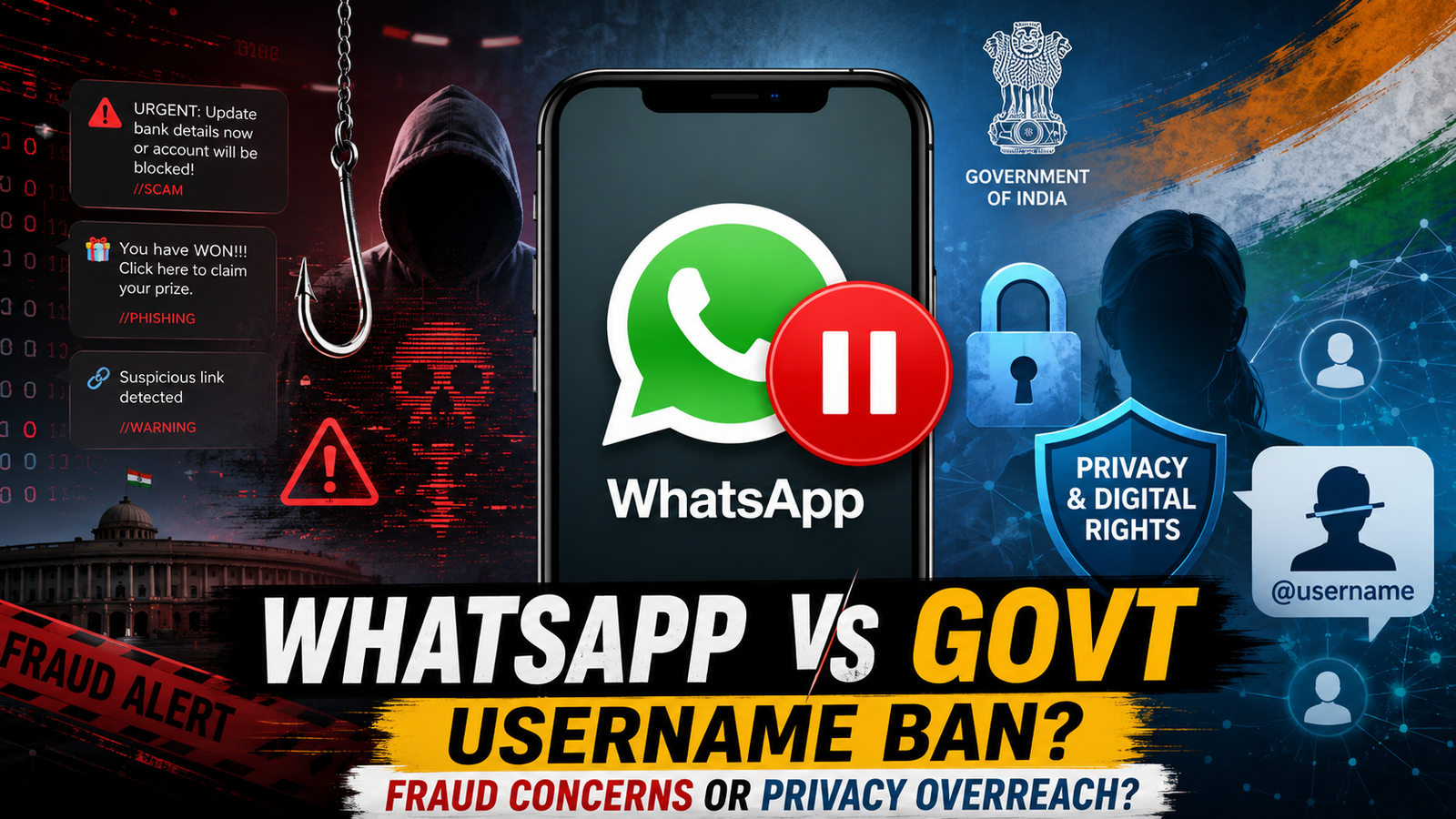
“Pause the rollout until consultations are completed to the satisfaction of the Government.”
That line, from a July 2026 notice by India’s Ministry of Electronics and Information Technology (MeitY) to Meta-owned WhatsApp, has set off one of the most significant tech-policy confrontations in recent years. It isn’t just about whether you can message someone without sharing your phone number. It’s about how much control the Indian state should have over software features, how it balances user privacy with crime prevention, and what this means for India’s digital economy.
This analysis unpacks what’s really at stake, separates rhetoric from evidence, and looks at the implications for users, enterprises, and the future of internet regulation in India—without taking sides.
What triggered the standoff?
In mid-2026, WhatsApp began letting users reserve unique usernames, with the full feature—messaging contacts via username instead of phone number—planned for a global rollout later in the year.
MeitY’s notice argued that this could:
-
“Materially increase” online fraud, phishing, digital arrest scams, and impersonation, because bad actors can reach victims without revealing any phone number.
-
Enable impersonation of individuals, government bodies, financial institutions, and public organizations by creating usernames that closely resemble legitimate ones.
-
Make it harder for law enforcement to identify perpetrators, especially if they use foreign numbers and hide behind usernames, complicating investigations and jurisdictional questions.
The ministry directed WhatsApp to:
-
Explain why no action should be taken against it under the IT Act and related rules on intermediary due diligence, identity theft, and impersonation.
-
Not roll out the feature in India until consultations are completed “to the satisfaction of the Government”.
Within days, similar notices went to Telegram, Signal, and even Indian apps like Arattai, which already support username-based messaging.
The government’s case: fraud, fear, and enforcement
The government’s position is not abstract. It is rooted in a very real, very painful surge in cyber fraud and “digital arrest” scams over the past few years.
-
Digital arrest scams alone saw more than 123,000 cases reported in 2024, with losses of around ₹1,918 crore, according to independent analyses of official data.[blogs.nahar]
-
Even if 2025–26 saw some decline in cases and losses, the absolute numbers remain huge, and public anxiety is high.[
-
Law enforcement agencies have repeatedly complained about anonymity and delayed responses from global platforms when seeking data for investigations.
From a policing perspective, the logic is straightforward:
-
If a scammer can create a profile with a foreign number, use a fake photo, and pick a username like “NIA_HelpDesk” or “Bank_Support_IN”, the victim sees no Indian phone number to trace or report easily.
-
For investigators, that removes an important initial clue: the country code and number metadata that can help establish jurisdiction and start the tracing process.
A Department of Telecommunications official put it bluntly:
“Earlier, if the number began with +91, we could at least initiate action. If the number isn’t available, there is virtually no way to resolve it.”
In that context, MeitY’s stance is less about “hating privacy” and more about trying to keep one more door closed for scammers, especially in a regime where platforms often respond slowly to law enforcement requests.
The other side: privacy, product design, and legal overreach
On the other side are privacy advocates, digital rights groups, and parts of the tech industry, who see the notice as a dangerous expansion of executive power.
The Internet Freedom Foundation (IFF) has called the move “Licence Raj for software features”, arguing that:
-
There is no clear legal provision that allows MeitY to pre-approve or block a product feature before it is released.
-
Sections of the IT Act that the notice cites—like Section 79 (safe harbour), and Sections 66C/66D (identity theft and cheating by personation)—are meant to define when intermediaries can be held liable and to punish actual offenders, not to give the government a feature-level veto.[
-
The IT Rules, 2021 impose due diligence and grievance obligations on platforms; they do not create a licensing regime for new functionalities.
-
The only provision that explicitly allows the government to control what appears online—Section 69A—is about blocking specific information, not dictating product design.
In IFF’s reading, the government is effectively turning intermediary liability rules into a backdoor control mechanism: “If you don’t do what we want with your feature, we may threaten to pull your safe harbour protection.”
MediaNama and other observers note a broader pattern: Indian authorities are increasingly using the threat of losing safe harbour to push platforms into feature-level changes, going well beyond takedowns or content blocking.
This matters because:
-
If MeitY can halt a username feature, what stops it from questioning end-to-end encryption, disappearing messages, or group admin controls in the future?
-
For startups and global companies, India risks being seen as a market where new features need a regulatory green light, which can slow innovation and push investment elsewhere.
What WhatsApp (and others) are actually proposing
It’s important to separate what the feature is from what critics fear it might become.
According to WhatsApp’s public explanations and media reports:
-
Users will still need a phone number to register on WhatsApp; usernames do not replace that.
-
The username feature is opt-in: users choose whether to create a username; they are not forced to.
-
Only people who know your exact username can message you via that handle; it’s not a public directory by default.
-
WhatsApp says it has built in safeguards such as:
-
Reserving high-profile usernames to prevent impersonation of public figures and institutions.
-
Mechanisms to detect and act against impersonation and scam patterns.
-
Telegram and Signal, which already support usernames, argue that:
-
Anonymity has legitimate uses: journalists, activists, abuse survivors, LGBTQ+ users, and whistleblowers often rely on not exposing their phone numbers to stay safe.
-
Fraud exists on all platforms, with or without usernames; the solution is better detection, reporting, and enforcement, not blanket restrictions on features.
From a product-design standpoint, usernames are not inherently “pro-fraud”; they are a privacy and usability tool that can also be misused, like almost any communication feature.
The data problem: where evidence meets assumption
A neutral analysis has to acknowledge two uncomfortable truths:
-
There is no public, peer-reviewed study showing that username-based messaging, by itself, causes a measurable jump in fraud rates compared to phone-number-based messaging.
-
At the same time, there is substantial evidence that cyber fraud in India is massive, evolving fast, and often carried out via messaging apps, social media, and VoIP—regardless of whether usernames are involved.
What we do know:
-
Digital arrest scams primarily use phone calls, video calls, and messaging to 恐吓 victims into believing they or their relatives are under investigation, then coerce them into transferring money.[
-
Many of these scams already rely on spoofed caller IDs, foreign numbers, and fake profiles; usernames would be just another layer, not the root cause.
-
Law enforcement’s biggest pain points are:
-
Cross-border operations (scammers often based outside India).
-
Slow or incomplete cooperation from platforms in providing metadata and user information.
-
Low conviction rates and complex jurisdictional issues.
-
In that sense, focusing only on usernames risks being both:
-
Too narrow: it treats a symptom rather than the deeper structural issues in cybercrime enforcement.
-
Too broad: it potentially restricts a feature used by millions of legitimate users based on a plausible but not yet proven risk.
Implications for Indian enterprises and startups
For businesses, this isn’t just a policy debate; it has concrete operational and strategic implications.
1) Messaging strategy and compliance risk
Indian companies using WhatsApp Business, Telegram channels, or in-app chat must now factor in:
-
The possibility that new messaging features (especially those enhancing anonymity) could be paused or modified in India due to regulatory intervention.
-
Higher scrutiny of any initiative that relies on aliases, hidden numbers, or semi-anonymous contact flows, especially in sensitive sectors like BFSI, health, e-commerce, and edtech.
Enterprises may need to:
-
Strengthen KYC and verification for business accounts.
-
Invest in brand verification badges, official disclaimers, and in-app authenticity signals so customers can distinguish genuine business accounts from impostors.
-
Maintain alternative channels (email, SMS, verified business messaging, in-app chat) for critical communications.
2) Product design for the Indian market
For startups building chat-first products or integrating messaging:
-
They may have to design India-specific flows that:
-
Keep phone numbers visible or mandatory for certain use cases.
-
Add extra verification steps for high-risk interactions (financial transactions, account changes).
-
-
Product roadmaps may need to accommodate regulatory consultations before launching features that touch identity, anonymity, or encryption.
This adds cost and complexity, but also an opportunity: firms that can demonstrate strong anti-fraud systems, fast cooperation with law enforcement, and transparent policies may gain a competitive edge.
3) Platform risk and diversification
The fact that Telegram, Signal, and homegrown apps are also under notice signals a broader regulatory discomfort with anonymous messaging ecosystems.
For enterprises that rely on these platforms for:
-
Community building (Telegram groups, channels)
-
Customer support or niche segments
-
Internal communications
This adds platform risk: features could be restricted, compliance expectations could rise, or public perception could turn negative. A prudent strategy is to diversify channels and avoid over-dependence on any single messaging app.
The bigger picture: India’s evolving internet governance model
Beyond usernames, this episode reveals a pattern in how India is approaching internet governance:
-
Security-first framing: Cyber fraud, national security, and public order are invoked as primary lenses, often overshadowing privacy and innovation concerns.
-
Executive-driven interventions: Ministries and agencies are increasingly using notices, consultations, and threats to safe harbour to influence platform behaviour, rather than waiting for legislation or court rulings.
-
Feature-level ambitions: The state is moving from content takedowns and blocking to wanting a say in how products are designed—a significant shift in the scope of regulation.
This approach has some merits:
-
It allows faster response to emerging threats like digital arrest scams.
-
It signals to platforms that India will not be a passive market where global products are deployed without local accountability.
But it also raises hard questions:
-
Where is the legal boundary between legitimate regulation and ad hoc executive control over software?
-
How do we ensure that privacy, free expression, and innovation are not continuously traded off in the name of security?
-
Can India develop a clear, predictable framework—through law and rule-making—rather than relying on case-by-case notices and pressure?
As the Internet Freedom Foundation warned, if this trend continues, platforms may effectively need a green signal from MeitY before rolling out any new feature in India.
A balanced way forward
A non-biased reading suggests that both sides have legitimate points:
-
The government’s concern about fraud and impersonation is real, data-backed, and politically salient. Ignoring it would be irresponsible.
-
The tech and civil society concern about legal overreach, lack of clear statutory basis, and chilling effects on innovation and privacy is also valid and deserves serious attention.
Potential middle paths could include:
-
Clearer legal framework
-
Amend or clarify the IT Act and rules to explicitly define:
-
What kinds of product-level regulations are permissible.
-
The process for raising concerns about new features (consultations, timelines, appeals).
-
-
This would reduce ad hocism and give both companies and citizens a predictable rulebook.
-
-
Risk-based, targeted safeguards instead of blanket bans
-
Instead of halting usernames entirely, regulators could push for:
-
Stricter controls on high-risk use cases (financial transactions, government impersonation).
-
Mandatory verification for business and institutional accounts.
-
Enhanced logging and rapid-response mechanisms for law enforcement requests, especially in fraud cases.
-
-
-
Better data sharing and transparency
-
Platforms should publish more transparency reports on fraud patterns, takedowns, and cooperation with Indian law enforcement.
-
The government should share more granular data on how different modalities (calls, SMS, messaging apps, usernames) are used in scams, to guide evidence-based policy.
-
-
User education and interface design
-
A large part of the fraud problem is user behavior and awareness.
-
Both platforms and the state can invest in:
-
Clearer in-app warnings for suspicious interactions.
-
Public campaigns on digital arrest scams, impersonation, and safe messaging practices.
-
-
Why this matters for you as a reader—and as a tech user
If you’re an ordinary user:
-
This fight will shape whether you can message without exposing your number, how easy it is to verify who you’re talking to, and how much of your digital identity is visible by default.
-
It will influence how quickly new features reach you in India compared to other markets.
If you’re a business or startup:
-
It will affect your messaging strategy, compliance costs, and product roadmap.
-
It will determine whether India is seen as a market where innovation is welcomed but responsibly governed, or one where features need prior approval.
If you care about democracy and rights:
-
This is a test case for how India balances security, privacy, and innovation in the digital age.
-
The precedents set here—on legal basis, executive power, and feature-level regulation—will echo in future debates over encryption, AI, and platform governance.
In the end, the WhatsApp username row is not really about usernames. It’s about who gets to decide how the internet works in India, and on what terms. The right outcome is unlikely to be “ban the feature” or “let everything go”. It’s more likely to be a nuanced, legally grounded framework that reduces fraud without turning every new feature into a regulatory battleground.